We didn't plan to open a new credit card this month, but we did. While booking a flight to Japan, we found something that changes how we get to Otaru, and a card offer that came with it.
Why this flight matters to us
Getting to Hokkaido has been the hardest part of our Japan plans. We travel with a dog, and we have so far avoided putting him in the cargo hold of a plane. We don't want to risk it. That means flying into Tokyo and taking the Shinkansen north.
That trip adds up. For the two of us it's about $500 one way on the Shinkansen from Tokyo to Shin-Hakodate-Hokuto. From there it's a regional train to Sapporo and New Chitose, and then the Hakodate line on to Otaru. Add the overnight hotel in Tokyo that the schedule almost forces on you, and it's a 10 to 12 hour travel day on top of the flight.
So when we started planning our return in March, we were delighted to find that we can now fly directly into Sapporo. With the train fare and the hotel night in Tokyo both gone, we estimate it saves us at least $1,000, plus a very long day. (Next time we do the long way, we may look at a rental car instead.)
United's seasonal nonstop, at a glance
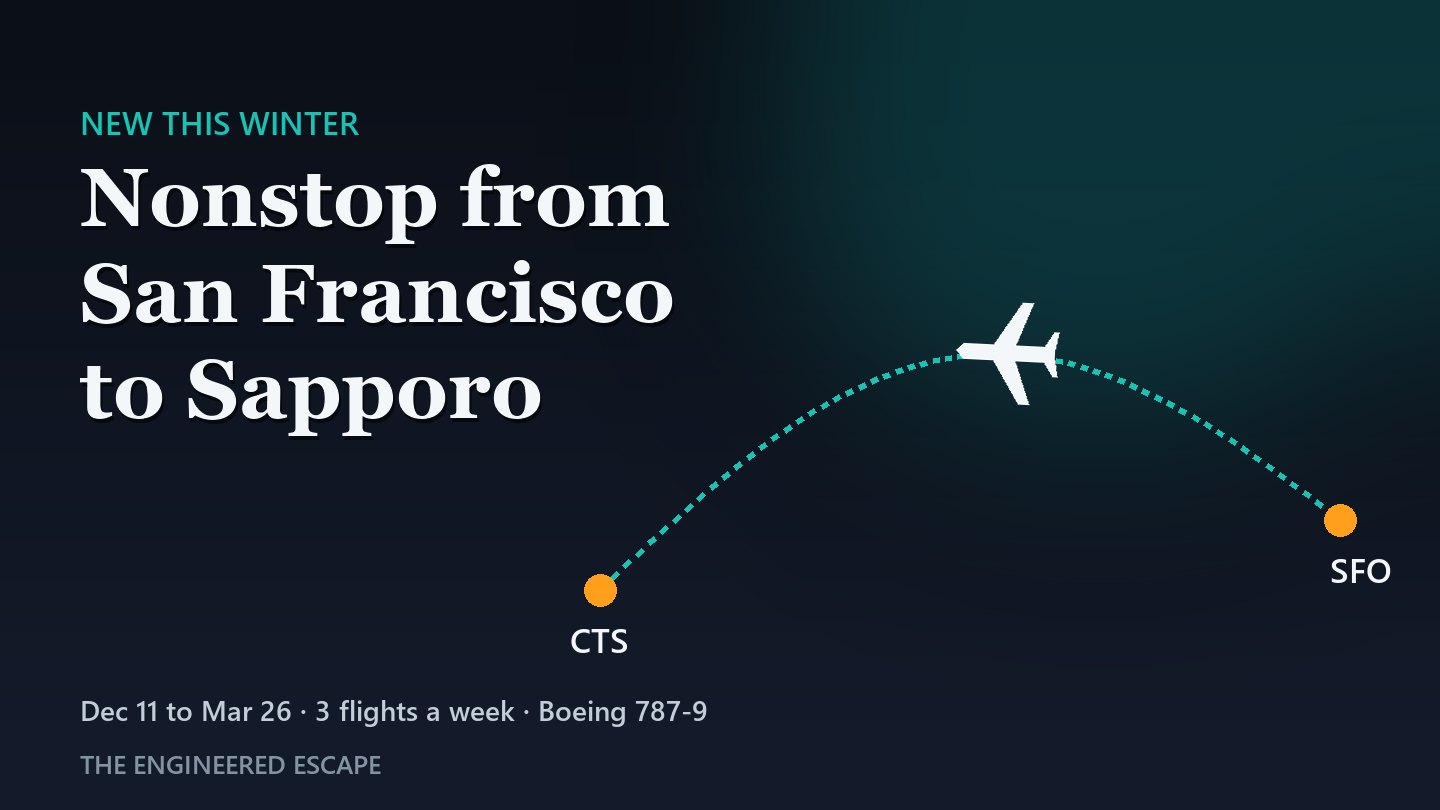
United says this is the first nonstop service between the continental US and Sapporo's New Chitose Airport. Here are the details as reported at launch (The Bulkhead Seat):
| Detail | What was announced |
|---|---|
| Route | San Francisco (SFO) to Sapporo New Chitose (CTS) |
| Season | Winter 2026–27: December 11 through March 26 |
| Frequency | Three times a week |
| Days | To Sapporo: Sunday, Wednesday and Friday. Back to San Francisco: Monday, Thursday and Saturday |
| Aircraft | Boeing 787-9: 48 Polaris, 21 Premium Plus, 39 Economy Plus and 149 Economy seats |
| On sale since | May 14, 2026 |
Schedules, times and dates can change, so confirm on united.com before you book. One nonstop a few times a week means it won't suit everyone, but if you're headed to the ski resorts around Sapporo and Niseko or to Otaru, it removes the Tokyo detour entirely. Travelers from many US cities can connect through San Francisco.

The card that came with it
When we were checking out on united.com, the site showed a banner for the United Explorer card from Chase. The offer on the application page was a $400 statement credit after your first purchase, plus 25,000 bonus miles after you spend $3,000 in the first three months, plus another 10,000 miles if you add an authorized user in that window. That's up to 35,000 bonus miles, which is how the banner described it.
The part that made it easy to say yes: if you're instantly approved, the new card is saved as the default payment in your MileagePlus profile. You can use it right away to buy your flight, and the statement credit posts on the same statement as the purchase.
The benefits, from the application page:
- $0 intro annual fee the first year, then $150.
- Free first checked bag for the primary cardmember and one companion on the same reservation, up to a $50 value each way per person. You need to include your MileagePlus number and buy the ticket with the card, though that purchase rule is waived for flights in the first 90 days after you open the account.
- Two United Club one-time passes each year.
- Group 2 priority boarding.
- Save 10% or more on flights booked with miles, with cardmember award pricing.
- Up to $120 toward a Global Entry, TSA PreCheck or NEXUS fee.
- 25% back as a statement credit on food, drinks and Wi-Fi on board United flights, and on premium drinks in the Club.
- No foreign transaction fees.
- Earning: 9x total miles on eligible United flights (6x for being a MileagePlus member plus 3x for using the card), 3x on other United purchases, 2x on dining and on hotels booked directly, and 1x on everything else.
For us it was a no-brainer. The first year costs nothing, and the statement credit effectively takes about $400 off a flight we were about to buy anyway. If the card proves worthwhile, we'll keep it for a second year. If not, we'll cancel before the fee comes around.
Which offer should you take?
The offer we took was available from the United booking page. If you apply through a referral link or another route, you may instead see a larger mileage bonus after the spending requirement, but no $400 statement credit. As of early October, the widely advertised offer was 70,000 miles after $3,000 in the first three months, with the first-year fee waived (Points Party).
Our rule of thumb: if you plan to buy a United flight soon, the instant statement credit offered during booking is worth looking for. If you're not booking right now, the bigger mileage bonus may be the better deal. Offers vary by channel and change often, so use whichever is shown to you when you apply and read the terms.
If you'd like to use our link, here it is. We may earn a referral bonus if you're approved, at no cost to you:
The catches
A new card isn't free, even with no annual fee in the first year. Before you apply:
- Chase's 5/24 rule. Chase is likely to decline you if you've opened five or more personal credit cards, from any issuer, in the past 24 months (The Points Guy). Count yours first.
- Bonuses once per 24 months. The offer is only for people who don't already have the card and haven't received a bonus for it in the past 24 months. Check the terms on the application page.
- A hard credit inquiry, and one more account to track. Applications too close together can also draw extra scrutiny from Chase.
- The $150 fee in year two. Put a reminder on your calendar a month before it renews.
- It's a United card. The miles and perks only pay off if you actually fly United. For us it's the SFO to Sapporo flight; for you it may not be.
We keep our card strategy deliberately small and use each card on purpose. For how we think about the whole set, see our guide to travel credit cards for slow-traveling couples. This is general information from our own experience, not financial advice. Check the issuer's page for current terms before you apply. Everything in this post was current as of late October 2026.
Bottom line
The nonstop is the real news. A direct flight to Sapporo saves us a Tokyo hotel night, about $500 in train fares each way, and a 10 to 12 hour travel day, which matters even more with a dog. The Explorer card is a nice bonus if you'll fly United anyway, and the first year's no annual fee makes it easy to try.
We'll report back on the flight in March. If you're planning a Hokkaido ski trip or a visit to Otaru, the Japan section has the rest of our story.